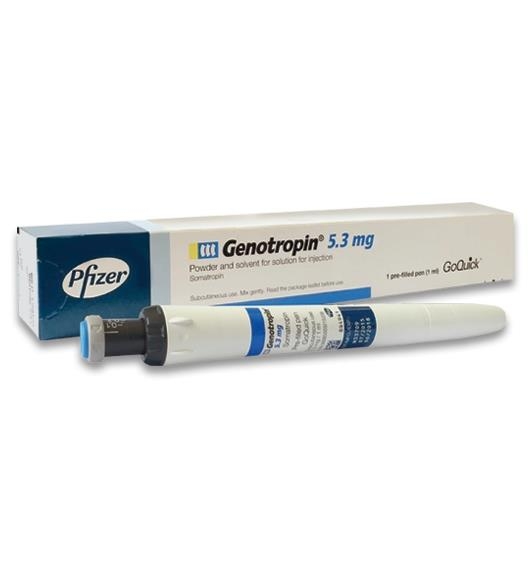
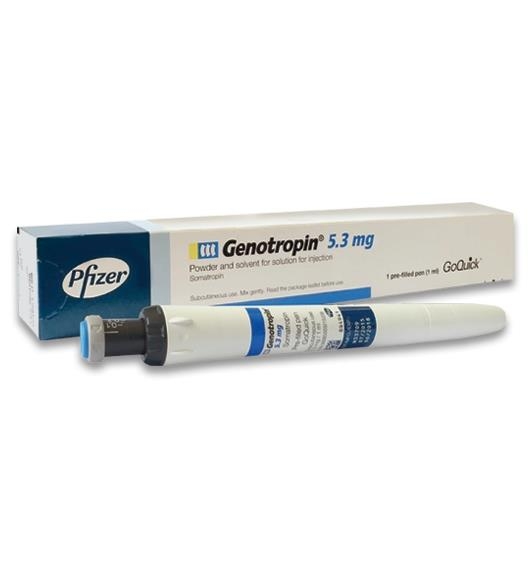
Somatropin (INN) recombinant DNA-derived human growth hormone produced in E.coli.
GENOTROPIN 5.3 mg powder and solvent for solution for injection, with preservative. One cartridge contains 5.3 mg somatropin*. After reconstitution the concentration of somatropin is 5.3 mg/ml.
GENOTROPIN 12 mg powder and solvent for solution for injection, with preservative. One cartridge contains 12 mg somatropin*. After reconstitution the concentration of somatropin is 12 mg/ml.
* produced in Escherichia coli cells by recombinant DNA technology.
Two-chamber cartridge: Powder and solvent for solution for injection. In the two-chamber cartridge there is a white powder in the front compartment and a clear solution in the rear compartment.
The two-chamber cartridge is supplied for use in a sealed disposable multidose pre-filled pen (GoQuick).
Excipients/Inactive Ingredients: Front compartment (powder): Glycine; Mannitol; Sodium dihydrogen phosphate, monohydrate; Disodium phosphate, dodecahydrate.
Rear compartment (solvent): Water for injections, Metacresol, Mannitol.
Pharmacotherapeutic group: Anterior pituitary lobe hormones and analogues. ATC code: H01A C01.
Pharmacology: Pharmacodynamics: Somatropin is a potent metabolic hormone of importance for the metabolism of lipids, carbohydrates and proteins. In children with inadequate endogenous growth hormone, somatropin stimulates linear growth and increases growth rate. In adults, as well as in children, somatropin maintains a normal body composition by increasing nitrogen retention and stimulation of skeletal muscle growth, and by mobilization of body fat. Visceral adipose tissue is particularly responsive to somatropin. In addition to enhanced lipolysis, somatropin decreases the uptake of triglycerides into body fat stores. Serum concentrations of IGF-I (Insulin-like Growth Factor-I), and IGFBP3 (Insulin-like Growth Factor Binding Protein 3) are increased by somatropin. In addition, the following actions have been demonstrated: Lipid metabolism: Somatropin induces hepatic LDL cholesterol receptors, and affects the profile of serum lipids and lipoproteins. In general, administration of somatropin to growth hormone deficient patients results in reductions in serum LDL and apolipoprotein B. A reduction in serum total cholesterol may also be observed.
Carbohydrate metabolism: Somatropin increases insulin but fasting blood glucose is commonly unchanged. Children with hypopituitarism may experience fasting hypoglycaemia. This condition is reversed by somatropin.
Water and mineral metabolism: Growth hormone deficiency is associated with decreased plasma and extracellular volumes. Both are rapidly increased after treatment with somatropin. Somatropin induces the retention of sodium, potassium and phosphorus.
Bone metabolism: Somatropin stimulates the turnover of skeletal bone. Long-term administration of somatropin to growth hormone deficient patients with osteopenia results in an increase in bone mineral content and density at weight-bearing sites.
Physical capacity: Muscle strength and physical exercise capacity are improved after long-term treatment with somatropin. Somatropin also increases cardiac output, but the mechanism has yet to be clarified. A decrease in peripheral vascular resistance may contribute to this effect.
In clinical trials in short children born SGA doses of 0.033 and 0.067 mg/kg body weight per day have been used for treatment until final height. In 56 patients who were continuously treated and have reached (near) final height, the mean change from height at start of treatment was +1.90 SDS (0.033 mg/kg body weight per day) and +2.19 SDS (0.067 mg/kg body weight per day). Literature data from untreated SGA children without early spontaneous catch-up suggest a late growth of 0.5 SDS.
Pharmacokinetics: Absorption: The bioavailability of subcutaneously administered somatropin is approximately 80% in both healthy subjects and growth hormone deficient patients. A subcutaneous dose of 0.035 mg/kg of somatropin results in plasma Cmax and tmax values in the range of 13-35 ng/ml and 3-6 hours respectively.
Elimination: The mean terminal half-life of somatropin after intravenous administration in growth hormone deficient adults is about 0.4 hours. However, after subcutaneous administration, half-lives of 2-3 hours are achieved. The observed difference is likely due to slow absorption from the injection site following subcutaneous administration.
Sub-populations: The absolute bioavailability of somatropin seems to be similar in males and females following s.c. administration.
Information about the pharmacokinetics of somatropin in geriatric and pediatric populations, in different races and in patients with renal, hepatic or cardiac insufficiency is either lacking or incomplete.
Toxicology: Preclinical Safety Data: In studies regarding general toxicity, local tolerance and reproduction toxicity no clinically relevant effects have been observed.
In vitro and in vivo genotoxicity studies on gene mutations and induction of chromosome aberrations have been negative.
An increased chromosome fragility has been observed in one in-vitro study on lymphocytes taken from patients after long term treatment with somatropin and following the addition of the radiomimetic drug bleomycin. The clinical significance of this finding is unclear.
In another study, no increase in chromosomal abnormalities was found in the lymphocytes of patients who had received long term somatropin therapy.
Children: Growth disturbance due to insufficient secretion of growth hormone (growth hormone deficiency, GHD) or growth disturbance associated with Turner syndrome or chronic renal insufficiency.
Growth disturbance [current height standard deviation score (SDS) Prader-Willi syndrome (PWS), for improvement of growth and body composition. The diagnosis of PWS should be confirmed by appropriate genetic testing.
Adults: Replacement therapy in adults with pronounced growth hormone deficiency.
Adult Onset: Patients who have severe growth hormone deficiency associated with multiple hormone deficiencies as a result of known hypothalamic or pituitary pathology, and who have at least one known deficiency of a pituitary hormone not being prolactin. These patients should undergo an appropriate dynamic test in order to diagnose or exclude a growth hormone deficiency.
Childhood Onset: Patients who were growth hormone deficient during childhood as a result of congenital, genetic, acquired, or idiopathic causes. Patients with childhood onset GHD should be reevaluated for growth hormone secretory capacity after completion of longitudinal growth. In patients with a high likelihood for persistent GHD, i.e. a congenital cause or GHD secondary to a pituitary/hypothalamic disease or insult, an insulin-like growth factor-I (IGF-I) SDS All other patients will require IGF-I assay and one growth hormone stimulation test.
The dosage and administration schedule should be individualized.
The injection should be given subcutaneously and the site varied to prevent lipoatrophy.
Growth Disturbance due to Insufficient Secretion of Growth Hormone in Children: Generally a dose of 0.025 - 0.035 mg/kg body weight per day or 0.7 - 1.0 mg/m2 body surface area per day is recommended. Even higher doses have been used.
Where childhood onset GHD persists into adolescence, treatment should be continued to achieve full somatic development (e.g. body composition, bone mass). For monitoring, the attainment of a normal peak bone mass defined as a T score > - 1 (i.e. standardized to average adult peak bone mass measured by dual energy X-ray absorptiometry taking into account sex and ethnicity) is one of the therapeutic objectives during the transition period. For guidance on dosing see adult section as follows.
Prader-Willi Syndrome, for Improvement of Growth and Body Composition in Children: Generally a dose of 0.035 mg/kg body weight per day or 1.0 mg/m2 body surface area per day is recommended. Daily doses of 2.7 mg should not be exceeded. Treatment should not be used in children with a growth velocity of less than 1 cm per year and near closure of epiphyses.
Growth Disturbances due to Turner Syndrome: A dose of 0.045 - 0.050 mg/kg body weight per day or 1.4 mg/m2 body surface area per day is recommended.
Growth Disturbance in Chronic Renal Insufficiency: A dose of 0.045 - 0.050 mg/kg body weight per day (1.4 mg/m2 body surface area per day) is recommended. Higher doses can be needed if growth velocity is too low. A dose correction can be needed after six months of treatment.
Growth Disturbance in Short Children Born Small for Gestational Age (SGA): A dose of 0.035 mg/kg body weight per day (1 mg/m2 body surface area per day) is usually recommended until final height is reached (see Pharmacology: Pharmacodynamics under Actions). Treatment should be discontinued after the first year of treatment if the height velocity SDS is below + 1.
Treatment should be discontinued if height velocity is 14 years (girls) or >16 years (boys), corresponding to closure of the epiphyseal growth plates. (See Table 1.)